A BRAND NEW 6-PART SHORT COURSE
LAUNCHING MAY 2026
Epistemic Injustice, Oppression & Ignorance: A Deeper Dive for Social Researchers
Enhance your conceptual toolkit with our accessible but detailed introduction to concepts every social researcher should know
A BRAND NEW
6-PART SHORT COURSE
LAUNCHING MAY 2026
Epistemic Injustice, Oppression & Ignorance: A Deeper Dive for Social Researchers
Enhance your conceptual toolkit with our accessible but detailed introduction to concepts every social researcher should know
Deepen your understanding of essential research concepts
including 'epistemic injustice', 'epistemic oppression' and 'epistemologies of ignorance'
Get bespoke training to support your research in our new short course
£47 beta price in exchange for your feedback
6 x 40-minute live classes with 20-minute Q&A plus replays.
Access to a dedicated Telegram group to connect with fellow course participants.
Additional reading materials including key texts, analysis and case studies.
Bonus audio trainings.
Weekly text-based Q&A.
Get bespoke training to support your research in our new short course
£47 beta price in exchange for your feedback
6 x 40-minute live classes with 20-minute Q&A plus replays.
Access to a dedicated Telegram group to connect with fellow course participants.
Additional reading materials including key texts, analysis and case studies.
Bonus audio trainings.
Weekly text-based Q&A.
What You'll Learn
Module 1: Epistemic Injustice: Details, Developments and Applications
More detailed explanation and analysis of Miranda Fricker's work on epistemic injustice, including the two primary forms of testimonial and hermeneutical injustice, innovations and developments in the concept, plus applications emerging from fields as diverse as medicine, asylum studies, education and law.Module 2: Epistemic Oppression I: Texts and Contexts
More detailed explanation and analysis of Kristie Dotson's work on epistemic oppression, focusing on the core texts and situating these in their theoretical and historical contexts as originating in Black and Indigenous Feminist Social Theory and Epistemology.Module 3: Epistemic Oppression II: Details and Applications
Expanding our understanding of the conceptual landscape emerging from Dotson's work on epistemic oppression and its applications. This includes notions like testimonial smothering, testimonial quieting, unknowability, process-based invisibilities, pernicious ignorance, and the seizure of epistemic power in relation to cases like the public scandal involving Nafissatou Diallo and Dominique Strauss-Kahn, the murder of Michael Brown, and the Tanzanian healthcare system.Module 4: Epistemologies of Ignorance and White Ignorance
More detailed explanation and analysis of Charles W. Mills's work on epistemologies of ignorance and white ignorance, exploring key texts that develop and expand these concepts as crucial components of white supremacy as a social and political system and the epistemology of Whiteness via mechanisms like historical erasure.Module 5: Privileged Group Ignorance and Agnotology
Expanding our understanding of ignorance as a critical analytical lens and epistemological framework, both within philosophical work on epistemologies of ignorance and in the broader fields of ignorance studies and agnotology. We'll consider work on other privileged group ignorances, such as gendered ignorance via the work of Nancy Tuana on ignorance in women's health and medicine, Christine Wieseler's work on nondisabled ignorance, and a range of other cases and applications.Module 6: Situating Epistemic Injustice, Oppression and Ignorance in Social Research
We'll bring it all together to explore how epistemic injustice, oppression and ignorance are being used to inform social research across a wide variety of disciplines and specialisations, as well as exploring recent innovations and applications such as a their inclusion in national an international policy and the attempt to develop metrics to support quantitative as well as qualitative analysis.
Book early for more bonuses
Cart closes on 22 April, with limited places available.
Even if we run the course again later in the year, the price will never be this low again!
Bonus #1:
Get personalised feedback on a written piece of work of 2000-words or less, e.g. a research proposal, literature review, writing excerpt.
Book by 8 April 2026
Bonus #2:
Get a 45-minute 1:1 session with Zara for bespoke signposting on epistemic injustice, epistemic oppression, epistemologies of ignorance and related concepts and literature for your project
Book by 13 April 2026
Bonus #3:
Receive an extended annotated bibliography (including videography) on epistemic injustice, epistemic oppression and epistemologies of ignorance
Book by 18 April 2026
When will classes take place?
Module 1: 5 May 2026 at Tuesday 7pm GMT via Zoom
Module 2: 12 May 2026 at Tuesday 7pm GMT via Zoom
Module 3: 19 May 2026 at Tuesday 7pm GMT via Zoom
BREAK FOR UK HALF TERM/CATCH-UP
Module 4: 2 June 2026 at Tuesday 7pm GMT via Zoom
Module 5: 9 June 2026 at Tuesday 7pm GMT via Zoom
Module 6: 16 June 2026 at Tuesday 7pm GMT via Zoom
Transform your research trajectory with expert-led guidance, training and insight into cutting-edge concepts from social epistemology to help you develop your theoretical and methodological frameworks

Your Host
Dr Zara Bain
Founder of Academic Audio Transcription
Honorary Research Associate, Philosophy @ University of Bristol /
Secrecy, Power & Ignorance Network (SPIN) Research Fellow
Zara Bain is an expert in social justice and social entrepreneur helping researchers, educators, and online businesses make knowledge--and knowledge-creation--more accessible.
Zara has a PhD in social & political philosophy and social epistemology from the University of Bristol, with particular emphasis on epistemologies of ignorance and epistemic oppression as features of socio-political systems like white supremacy and disability/ableism, as well as the work of late Jamaican-American political philosopher, Charles W. Mills (author of various books, most famously The Racial Contract).
Zara's work has been published in numerous prestigious international volumes, including the Routledge International Handbook of Ignorance Studies, as well as featured in The Guardian, The Times Higher Educational Supplement and The Philosopher 1923. She is also co-author of the world's first truly intersectional general introduction to philosophy, Philosophy: A Crash Course.
As a disabled, chronically ill and neurodivergent researcher, Zara founded research-specialist transcription and closed-captioning social enterprise, Academic Audio Transcription, in 2017, after realising that if she wanted flexible, fairly-paid remote work accessible from bed or while housebound during medical leave from her doctoral studies, she'd need to build it herself.
She lives in West London with her partner and two little boys, and in her spare time can be found walking in the woods, experimenting with new recipes, or volunteering at her local city farm.
Will this short course be recorded?
What accessibility measures will be in place?
The course will take place over a combination of Zoom for live classes and Telegram for group chats, audio trainings, additional resources and other readings.
We will also provide a course portal with a student login to enable easy access to class replays and to act as a repository for readings and other materials.
All of our live sessions include automated live captions as standard, although we recognise that these are an imperfect solution.
There will not be Sign Language Interpreting available at live events due to budgetary constraints, but we aim to include BSL interpreting at future sessions as soon as possible.
Class replays will be emailed to all course participants within 24 hours of each live session, and will include Zoom-native automated closed-captions. Course participants will also receive a PDF copy of any slides, including image descriptions/alt text.
Around 7-10 days after each live class, we'll update the replay with high-quality, accessibility-first closed captions alongside a publication-ready transcript of the event (both supplied by Academic Audio Transcription).
If you have any questions about additional accessibility measures, please email us at [email protected].
Save your seat today and join us to expand your conceptual toolkit and enhance your research
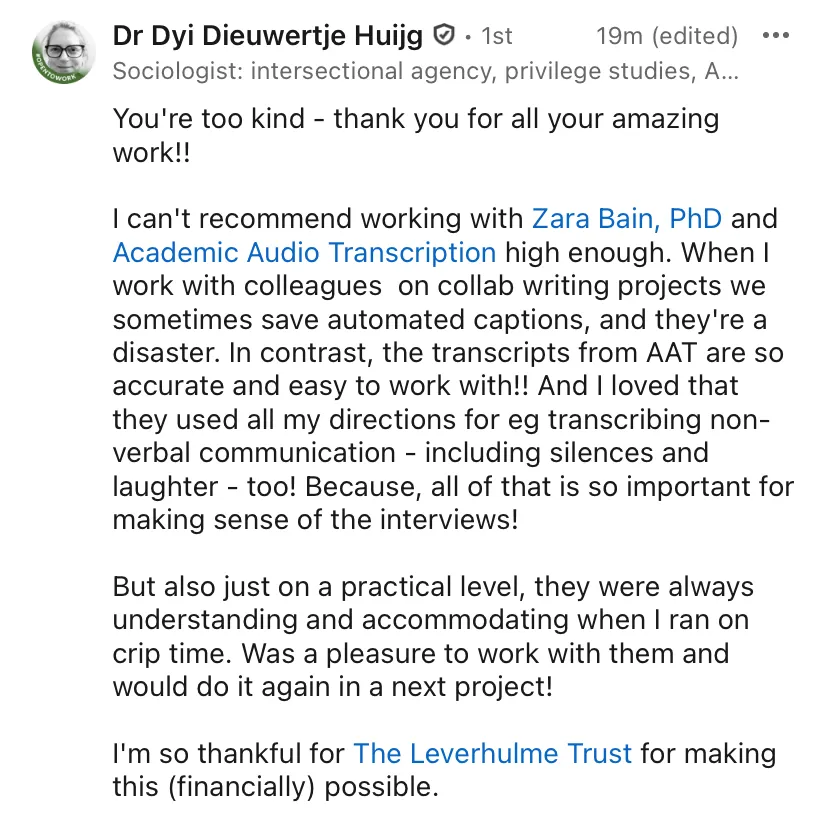
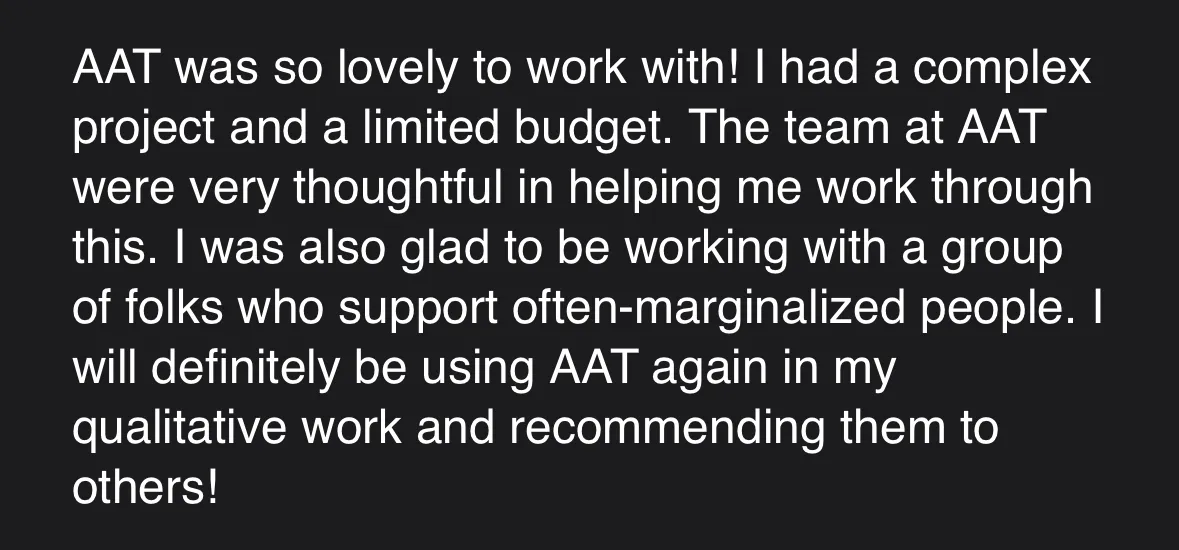
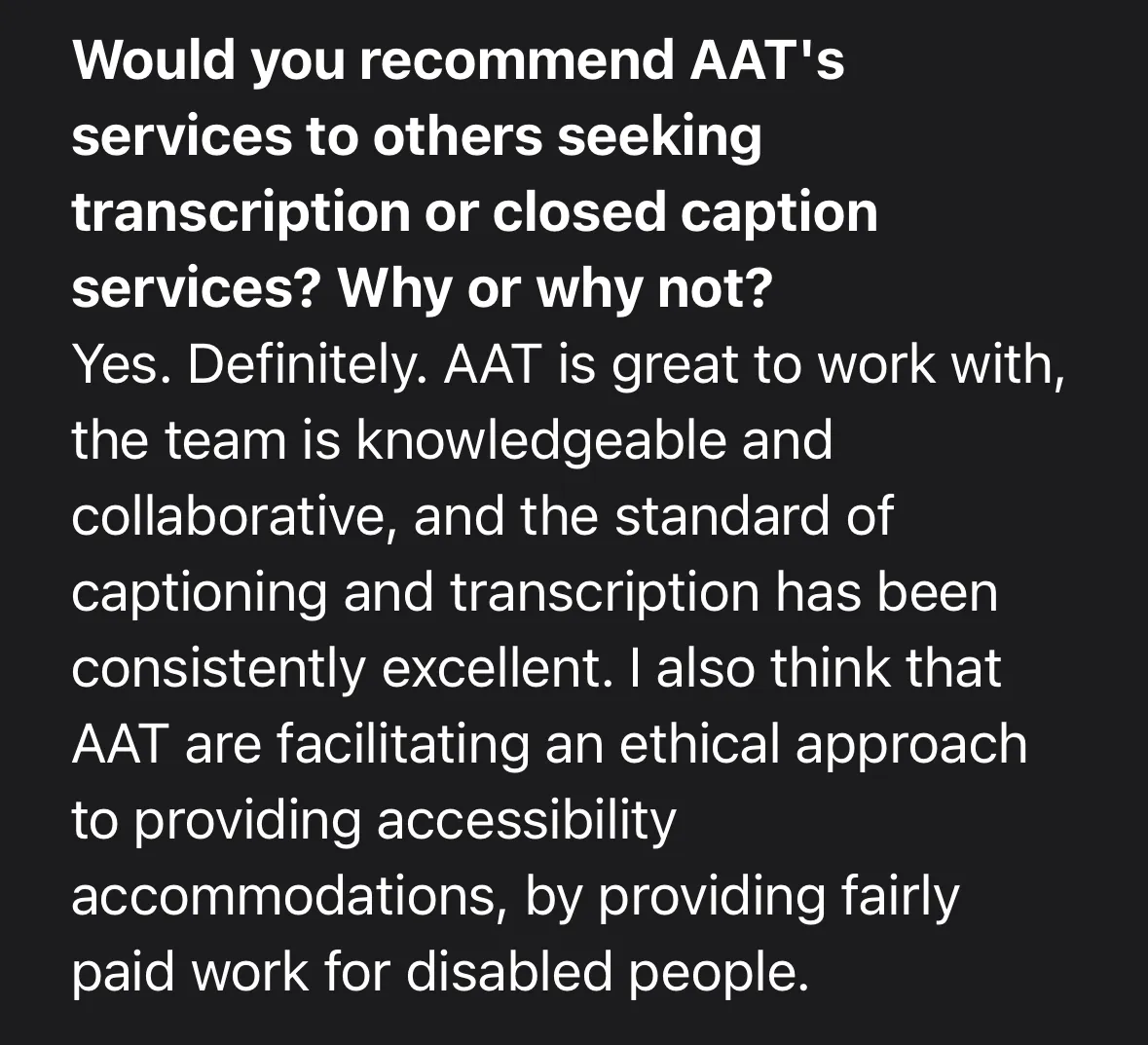
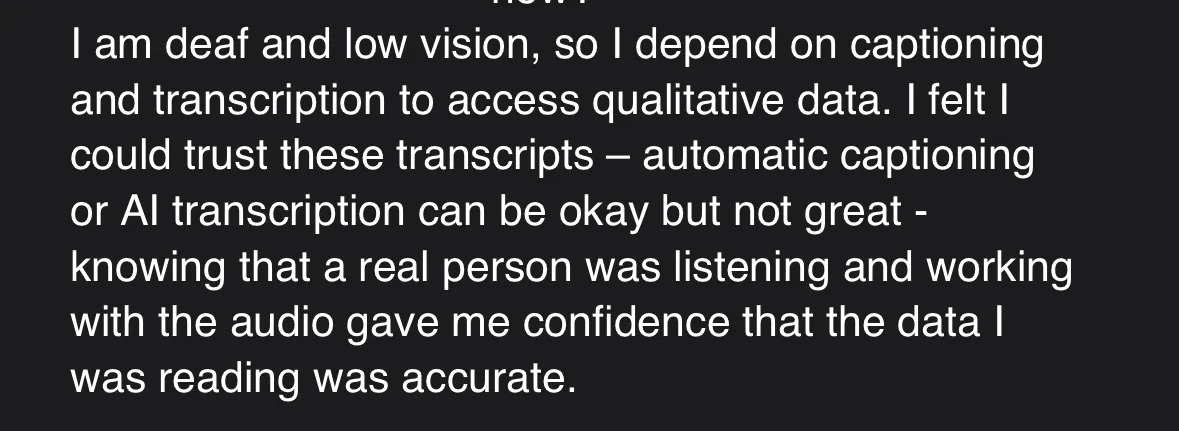
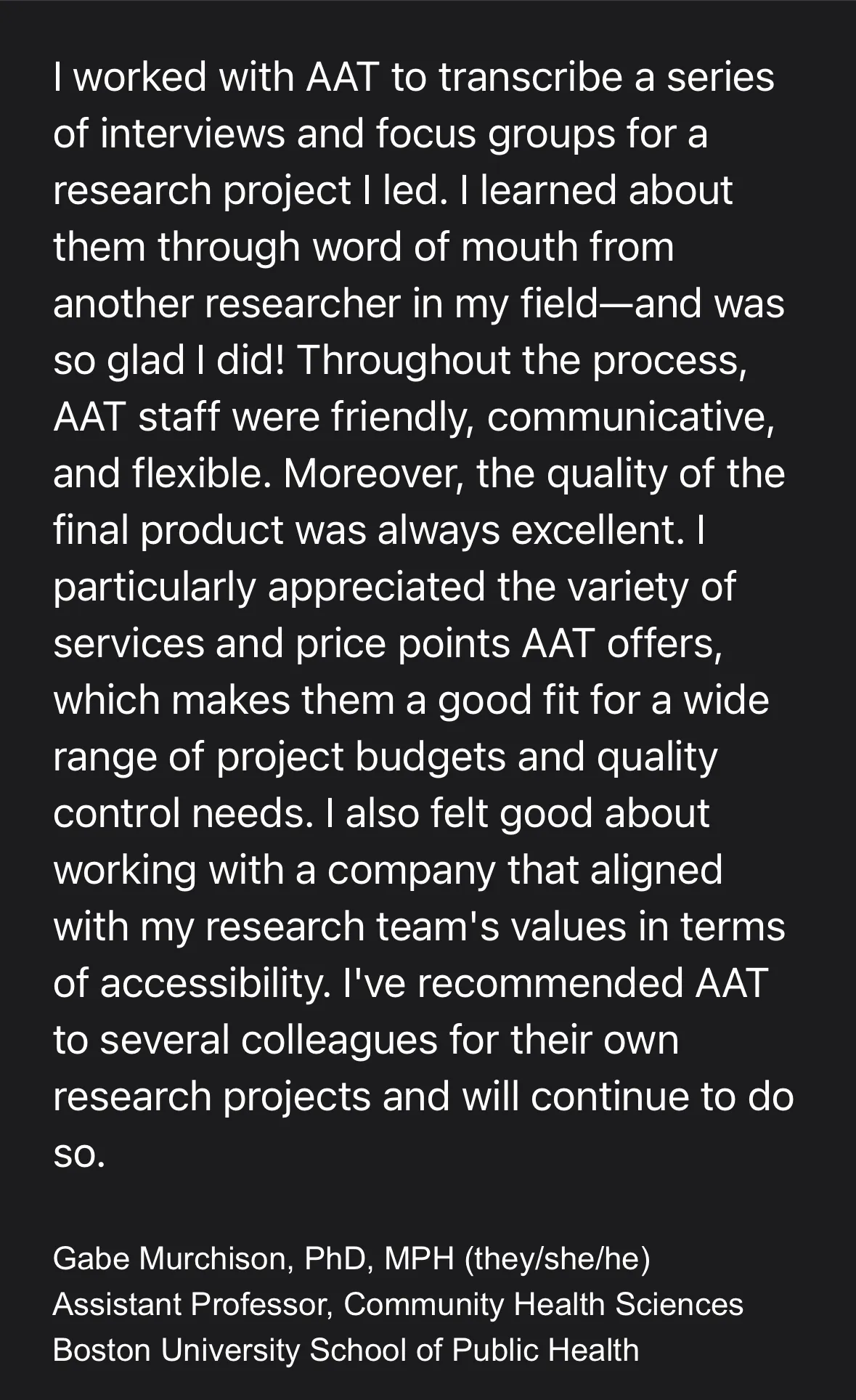
Nice words about your host,
Academic Audio Transcription
© Copyright. All Rights Reserved.

