
6-PART SHORT COURSE ON EPISTEMIC INJUSTICE THIS NOVEMBER
Epistemic Injustice, Oppression & Ignorance: A Deeper Dive for Social Researchers
Improve your confidence with complex philosophical concepts, frameworks and readings, and how best to use them in your research—without having to figure it all out on your own
STARTS 10 NOVEMBER 2026
6-PART SHORT COURSE ON EPISTEMIC INJUSTICE THIS NOVEMBER
Epistemic Injustice, Oppression & Ignorance: A Deeper Dive for Social Researchers
Improve your confidence with complex philosophical concepts, frameworks and readings, and how best to use them in your research—without having to figure it all out on your own
STARTS
10 NOVEMBER 2026
HELLO, RESEARCHER!
Are you:
Interested in knowledge-based harms, epistemic wrongdoing or injustices relating to whose knowledge counts, who gets to count as a knower, and who gets to contribute to processes and systems of knowledge-production?
Using or wanting to use epistemic injustice as a conceptual or theoretical framework for a current or future project, but struggling to navigate dense and frankly often confusing philosophical literature, not quite sure what the parts are and how they all fit together?
Investigating how your participants experience infringement on their epistemic agency, whether through their testimony being discredited, dismissed or ignored, or from their insights being excluded from what gets to 'count' as knowledge?
Struggling to find the right conceptual frameworks to think about cases that don't cleanly involve discrediting testimony or the absence of concepts, or which can track social phenomena like historical erasure, denialism, whitewashing, mystification, disavowal and refusal?
Then read on, my friends, because you are in exactly the right place.
Get bespoke help with our accessible but detailed introduction to philosophical concepts every social researcher should know
Get bespoke help with our accessible but detailed introduction to philosophical concepts every social researcher should know
GET THE SUPPORT YOU DESERVE
If you're anything like the hundreds of researchers globally that I've supported through workshops, webinars and the beta version of this short course, in every field imaginable, it's likely that you've had the 'a-ha!' moment that tracing knowledge-based harms and wrongs need to be a crucial part of your project.
But as the same time, so many of you have reported:
Finding it hard to navigate philosophical works as a non-philosopher (however much theory you've done in the past!), where the focus, structure and approach seems surprisingly different to what you're used to—and which is even more challenging trying to navigate largely alone.
Feeling like you need some extra support understanding key background and contextual information to grasp why this, and not that, why A and not B, and why the literature you're reading does what it does, the way it does.
Seeking spaces to connect with like-minded researchers motivated by similar questions—however different your projects, specialisation or training—where you can get some bespoke support to help you make good progress on your project, faster than you can manage alone.
I cannot stress this enough: You are not alone.
And believe it or not? I built this course just for you.
WHAT PAST STUDENTS HAVE SAID
I found the six week course extremely helpful, Zara has a wealth of knowledge in this area and she is very approachable if you have any questions. The course provides access to a huge amount of resources. For me, it helped to understand how Epistemic Injustice has developed from Fricker's original theory and how alternative frameworks have developed since and built on Fricker's original work.
It's really driven my thinking forward on EI & EO... it's allowed me to shift the framing in my thesis to using Epistemic Oppression and to have the confidence to do so even though it's less 'trendy' and legible... I am more able to confidently explain and defend why Epistemic Oppression offers the type of framework I need (& fully captures the contributions of EI). I'm also excited to be able to use Epistemic Oppression in teaching with healthcare trainees/professionals.
Gain a deeper understanding of essential conceptual frameworks for thinking about, and tracking, knowledge-based harms and wrongs, including 'epistemic injustice', 'epistemic oppression' and 'epistemologies of ignorance'
WHAT YOU'LL LEARN
Module 1: Epistemic Injustice: Details, Developments and Applications
More detailed explanation and analysis of Miranda Fricker's work on epistemic injustice, including the two primary forms of testimonial and hermeneutical injustice, innovations and developments in the concept, plus applications emerging from fields as diverse as medicine, asylum studies, education and law.Module 2: Epistemic Oppression I: Texts and Contexts
More detailed explanation and analysis of Kristie Dotson's work on epistemic oppression, focusing on the core texts and situating these in their theoretical and historical contexts as originating in Black and Indigenous Feminist Social Theory and Epistemology.Module 3: Epistemic Oppression II: Details and Applications
Expanding our understanding of the conceptual landscape emerging from Dotson's work on epistemic oppression and its applications. This might include notions like testimonial smothering, testimonial quieting, unknowability, process-based invisibilities, pernicious ignorance, and the seizure of epistemic power in relation to cases like the public scandal involving Nafissatou Diallo and Dominique Strauss-Kahn, the murder of Michael Brown, and the Tanzanian healthcare system.Module 4: Epistemologies of Ignorance and White Ignorance
More detailed explanation and analysis of Charles W. Mills's work on epistemologies of ignorance and white ignorance, exploring key texts that develop and expand these concepts as crucial components of white supremacy as a social and political system and the epistemology of Whiteness via mechanisms like historical erasure.Module 5: Privileged Group Ignorance and Agnotology
Expanding our understanding of ignorance as a critical analytical lens and epistemological framework, both within philosophical work on epistemologies of ignorance and in the broader fields of ignorance studies and agnotology. We'll consider work on other privileged group ignorances, such as gendered ignorance via the work of Nancy Tuana on ignorance in women's health and medicine, Christine Wieseler's work on nondisabled ignorance, and a range of other cases and applications.Module 6: Situating Epistemic Injustice, Oppression and Ignorance in Social Research
We'll bring it all together to explore how epistemic injustice, oppression and ignorance are being used to inform social research across a wide variety of disciplines and specialisations, as well as exploring recent innovations and applications such as a their inclusion in national an international policy and the attempt to develop metrics to support quantitative as well as qualitative analysis.
WHEN ARE CLASSES?
Module 1: 10 November
Module 2: 17 November
Module 3: 24 November
Module 4: 1 December
Module 5: 8 December
Module 6: 15 December
All classes take place
online via Zoom on Tuesday evenings at 7pm UTC (London-time).
Transform your research trajectory with expert-led guidance, training and insight into cutting-edge concepts from social epistemology to help you develop your theoretical and methodological frameworks
WHO'S YOUR TEACHER?

Dr Zara Bain
Philosopher
Founder & CEO of Academic Audio Transcription
With over a decade's teaching experience across secondary, university and private settings, Zara is enthusiastic about communicating complex philosophical ideas with energy and clarity in ways that make them accessible to non-philosophers and philosophers alike.
Her PhD in Philosophy from the University of Bristol examined epistemologies of ignorance and epistemic oppression as features of socio-political systems like white supremacy and disability/ableism in relation to the work of late Jamaican-American political philosopher, Charles W. Mills (best known for his 1997 book, The Racial Contract).
Zara's work has been published in various venues, including the Routledge International Handbook of Ignorance Studies, and featured in The Guardian, The Times Higher Educational Supplement and The Philosopher 1923. She is also co-author of the world's first truly intersectional general introduction to philosophy, Philosophy: A Crash Course.
As a disabled, chronically ill and neurodivergent researcher, Zara founded research-specialist transcription and closed-captioning social enterprise, Academic Audio Transcription, in 2017, after realising that if she wanted flexible, fairly-paid remote work accessible from bed or while housebound during medical leave from her doctoral studies, she'd need to build it herself.
She lives in West London with her partner and two little boys, and in her spare time can be found walking in the woods, experimenting with new recipes, or volunteering at her local city farm.
CHOOSE YOUR PACKAGE
REPLAY & OTHER ACCESSIBILITY INFO
The course will take place over a combination of Zoom for live classes and Telegram for group chats, audio trainings, additional resources and other readings.
Class replays will be emailed to all course participants 24-48 hours after each live session, and will include Zoom-native automated closed-captions.
All students receive access to a dedicated Course Portal containing class materials, readings, replays and more.
All live sessions include automated live captions as standard, although we recognise that these are an imperfect solution.
There will not be Sign Language Interpreting available at live events due to budgetary constraints, but we aim to include BSL interpreting at future sessions as soon as possible.
After each session, course participants will receive a PDF copy of any slides, including image descriptions/alt text.
If you have any questions about additional accessibility measures, please email us at [email protected].
FREQUENTLY ASKED QUESTIONS
Is it a problem if I've never studied philosophy before?
Not at all! The whole point of the course is to support scholars who are seeking to engage philosophical materials but who haven't had formal training in philosophy.
While philosophical literature can seem quite austere and alienating if you've not read much of it before, especially where it trades in what can seem like obfuscating technicalities, it's a subject best encountered through dialogue and discussion, which is where these sessions should hopefully help.
We will assume no prior experience in philosophy, and include resources to support learning how to read philosophy compared to other disciplines. At the same time, students should be willing to get stuck in with challenging philosophical materials from day one, and embrace the fact that in philosophy, confusion is often a sign of good engagement and progress!
Will replays be available if I can't make the live classes?
Absolutely yes! All live classes will be recorded and replays will be circulated to students 48-72 hours after the session, if not before. Recordings will be posted to the Course Portal, as well as to our private YouTube channel, and students will be notified via email and Telegram wherever possible.
Will timings be strictly observed?
Alright, so I'll be honest: I can have a tendency to run-on with classes if there's appetite and availability for doing so amongst students. In the beta round, one key piece of feedback was that knowing this in advance would have enabled students to better plan around classes in terms of energy and diary management, so I'm raising this up front.
Likewise, my full disclosure is that I'm a disabled and chronically ill parent to two very young children with multiple other work commitments. I will try my very best to be consistent in when I provide materials in advance of sessions (something that will of course be a lot easier the second time around!) but I appreciate your flexibility and understanding around this if needed.
I've never used Telegram before. Is it free and easy to use?
In addition to our course portal, we'll be using Telegram to enable asynchronous text-based messaging across our cohort and between our students and Zara. Telegram is a free app similar to WhatsApp, but with features that make it uniquely suited to creating community- and group-based discussions. It has desktop, android and iOS versions. You can find out more about it here.
Can I pay by payment plan?
Absolutely. Every one of our offer tiers can be bought via a one-off payment for the full price of £99, £144 or £222 respectively, or alternatively, you can opt to pay via three monthly payments of a third of the price of whatever tier you're choosing.
Save your seat today and join us to expand your conceptual toolkit and enhance your research
ABOUT OUR SPONSORS
Our events are sponsored by Academic Audio Transcription Ltd, an unapologetically intersectional, disabled-majority social enterprise offering research-specialist, zero-AI transcription, closed-caption and accessibility support services to researchers in the UK, US and worldwide.
Want to learn more about how they can help you transform your research process and timelines? Visit https://academicaudiotranscription.com.
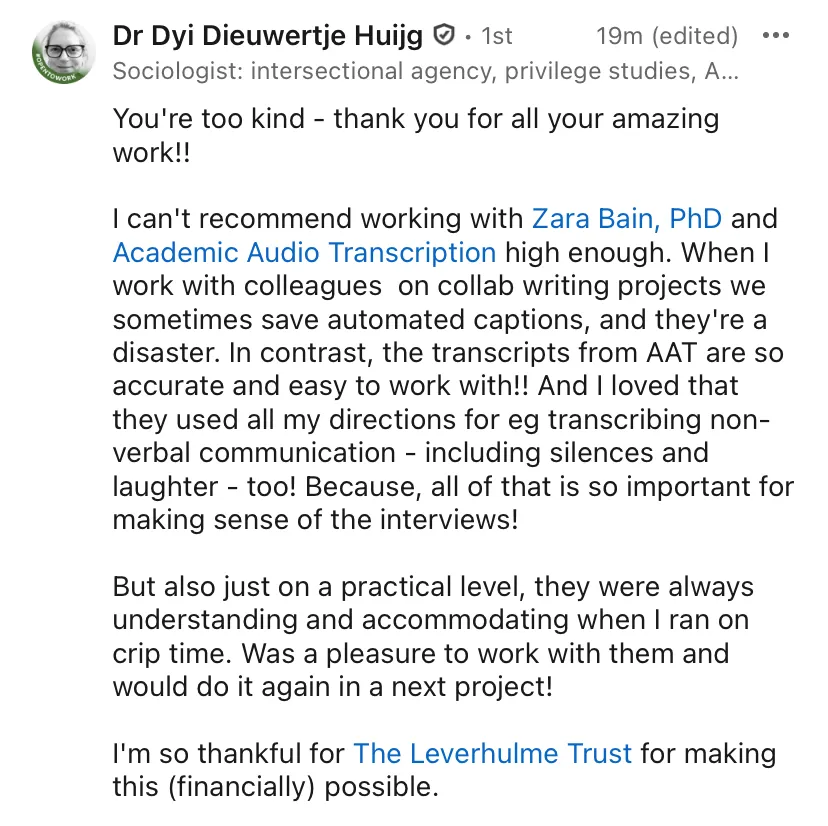
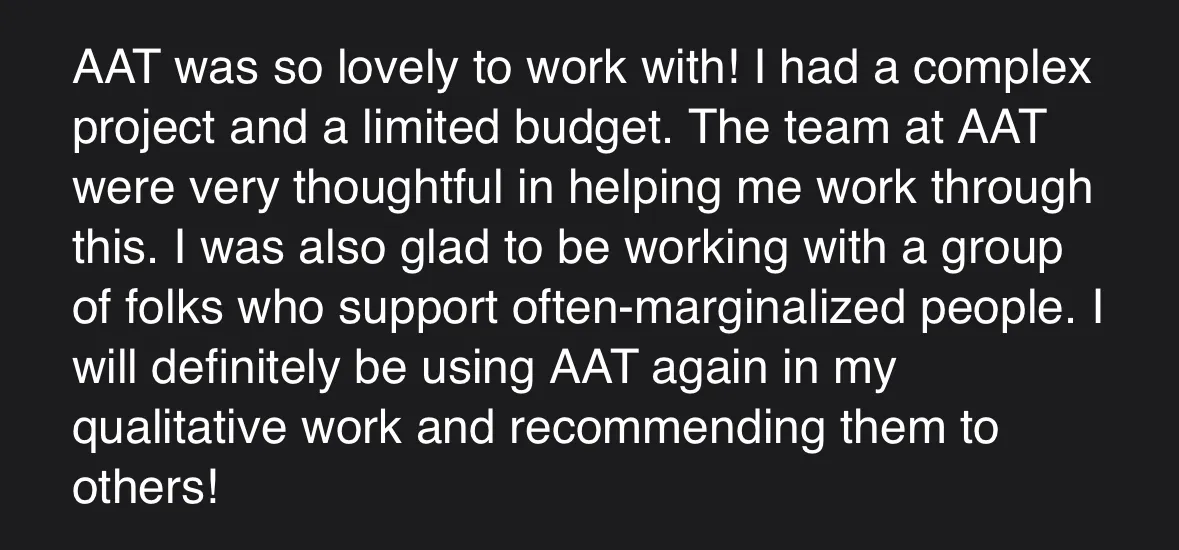
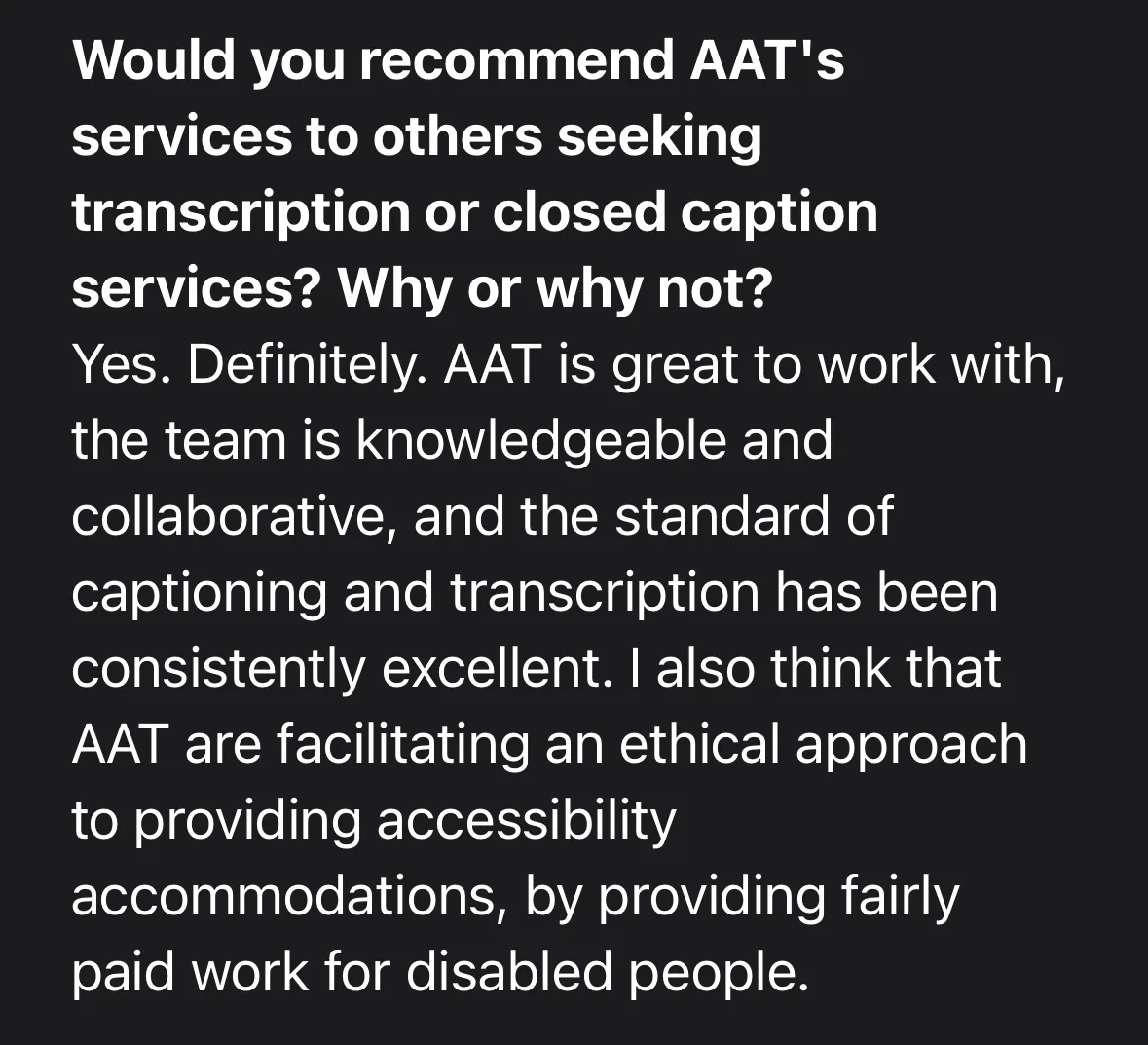
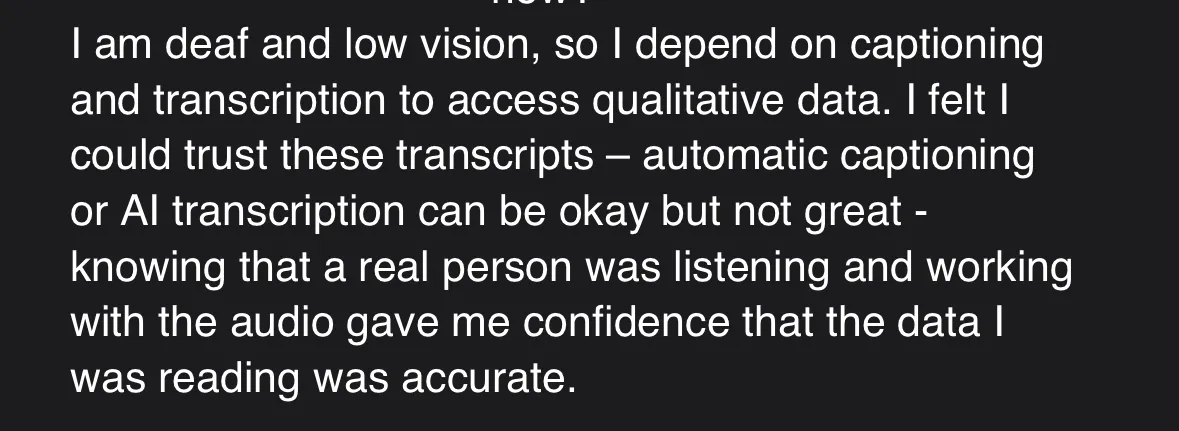
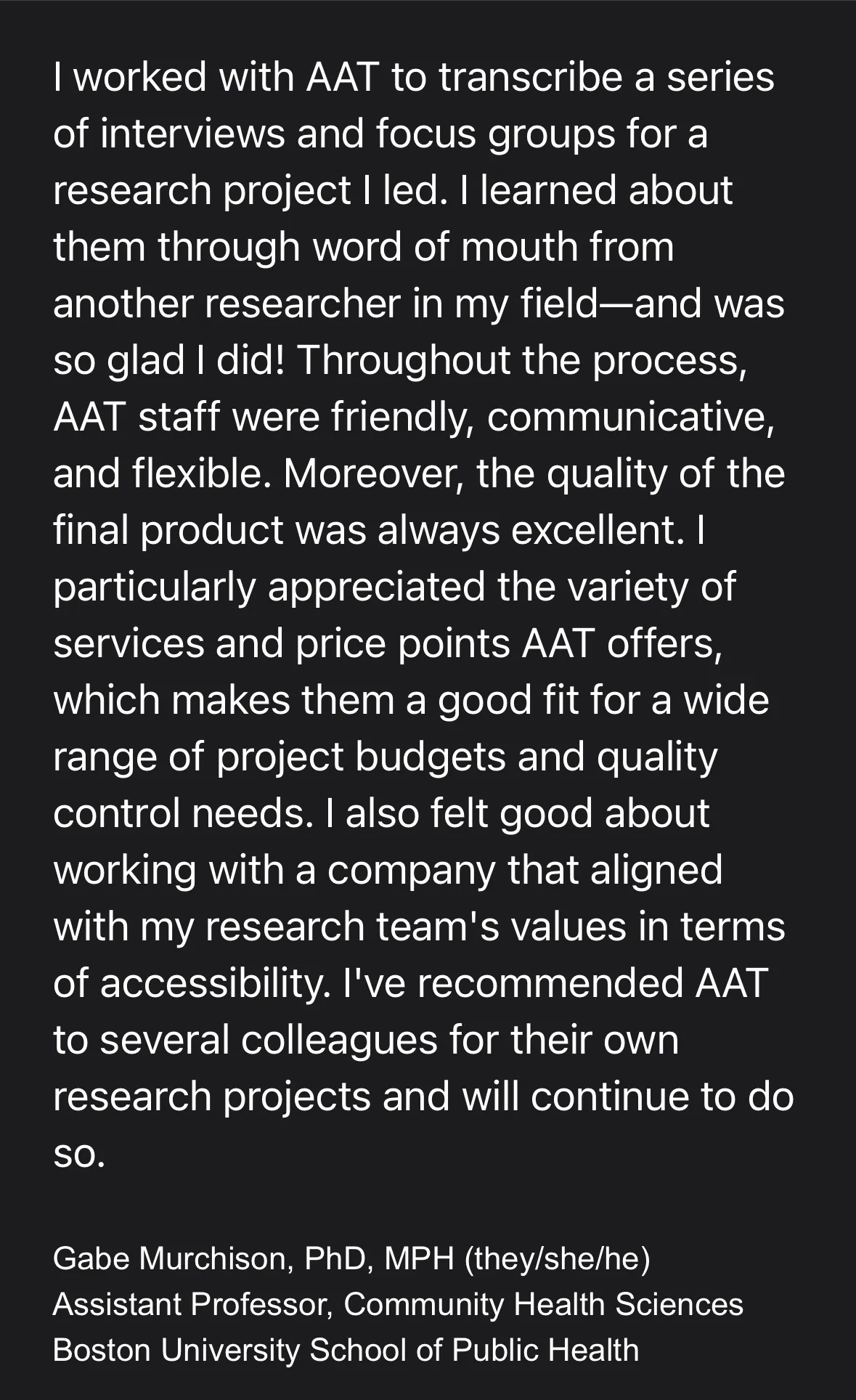
NICE WORDS ABOUT OUR SPONSORS
© Copyright. All Rights Reserved.

